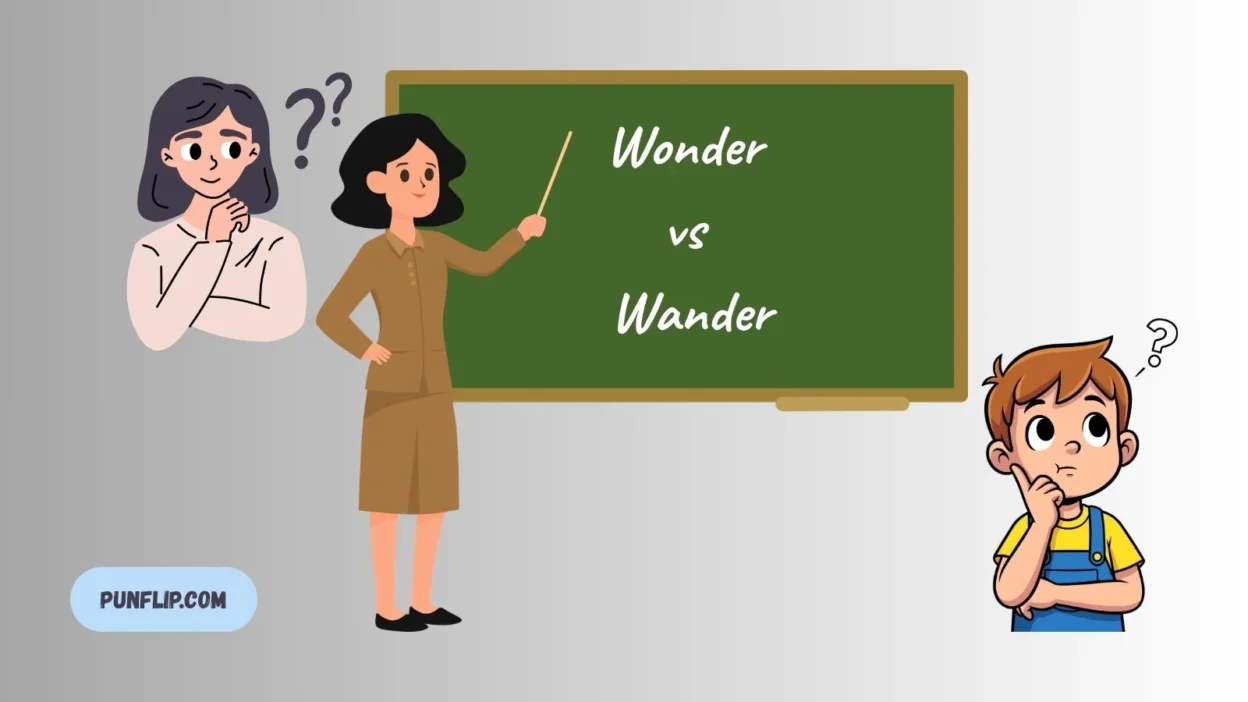
Have you ever paused while writing because you couldn’t remember whether to use wonder or wander? You’re not alone. These two words sound similar, differ by only one letter, and are commonly confused by English learners and even native speakers. However, they have completely different meanings and are used in different situations.
Understanding the difference between wonder vs wander can improve your writing, speaking, and overall confidence in English. In this guide, you’ll learn what each word means, when to use it, simple memory tricks, common mistakes, and plenty of real life examples. Whether you’re preparing for exams, improving business communication, or simply polishing your grammar, this article will help you master these commonly confused words.
Quick Answer
Wonder means to think, question, or feel curiosity about something. Wander means to move around without a fixed destination. If you’re thinking, use wonder. If you’re walking or moving aimlessly, use wander.
Why People Confuse It
The confusion happens because wonder and wander look and sound very similar. Both begin with w, end with -der, and are pronounced almost alike in fast speech.
Another reason is that both can describe experiences involving imagination or exploration. For example, someone may wonder about a new city before they wander through its streets. Since the actions can happen together, many writers accidentally replace one with the other.
Wonder
Wonder is mainly used as a verb and noun.
As a verb, it means to think about something with curiosity or uncertainty.
As a noun, it refers to amazement, admiration, or something extraordinary.
Examples
- I wonder where she went.
- We wondered if the weather would improve.
- The children looked at the stars in wonder.
- Everyone wondered why the meeting was canceled.
- I often wonder what the future holds.
Common meanings
- Feel curious
- Ask yourself a question
- Feel amazement
- Admire something incredible
Wander
Wander is usually a verb.
It means to move from place to place without a specific destination or purpose. It can also describe thoughts that drift away from the main topic.
Examples
- We wandered through the old town.
- Don’t wander too far from the campsite.
- His mind began to wander during the lecture.
- Tourists wandered around the museum.
- She loves to wander along the beach.
Common meanings
- Walk aimlessly
- Roam freely
- Drift mentally
- Explore casually
Comparison Table
| Feature | Wonder | Wander |
| Meaning | Feel curiosity or ask yourself a question | Move around without a destination |
| Part of Speech | Verb, noun | Verb |
| Focus | Thoughts, curiosity, amazement | Movement or drifting |
| Example | I wonder what’s next. | We wander through parks. |
| Keyword | Think | Walk |
When to Use Each
Use wonder when you’re talking about:
- Curiosity
- Questions
- Amazement
- Thinking about possibilities
- Surprise
Use wander when you’re talking about:
- Walking without direction
- Roaming freely
- Traveling casually
- Losing focus mentally
- Exploring places
Examples
Here are practical examples showing the difference.
- I wonder what time the train arrives.
- We wandered around the shopping mall.
- She wondered whether he remembered her birthday.
- Children wandered through the forest with a guide.
- Don’t let your thoughts wander during the exam.
- I wonder why birds migrate every year.
- They wandered across the countryside all afternoon.
- We all wondered how the magician performed the trick.
- Travelers wandered through ancient ruins.
- Sometimes I wonder if dreams have meaning.
- The puppy wandered into our garden.
- Scientists still wonder about the mysteries of space.
Common Mistakes
Many learners accidentally swap these words.
Incorrect: I wandered if she was coming.
Correct: I wondered if she was coming.
Incorrect: We wondered around the city.
Correct: We wandered around the city.
Incorrect: My mind wondered during class.
Correct: My mind wandered during class.
Memory Trick
A simple trick makes remembering easy.
- Wonder = Think. Both involve your mind and questions.
- Wander = Walk. Both involve movement.
Another helpful reminder:
Wonder asks. Wander walks.
American vs British English
The meanings of wonder and wander are the same in both American and British English.
The only noticeable difference may be pronunciation because of regional accents. Grammar, spelling, and usage remain consistent across both varieties of English.
Similar Words
These related words may also appear in similar contexts.
Similar to Wonder
- Curious
- Question
- Ponder
- Think
- Marvel
Similar to Wander
- Roam
- Stroll
- Meander
- Drift
- Explore
Knowing these synonyms helps improve vocabulary while avoiding repetition in writing.
Final Verdict
Although wonder and wander differ by only one letter, they describe completely different actions.
Choose wonder when you’re thinking, questioning, or feeling amazed.
Choose wander when you’re moving without a clear destination or when your attention drifts away.
Remember this simple rule:
Wonder happens in your mind. Wander happens with your feet—or sometimes your thoughts.
Frequently Asked Questions
Is it “I wonder” or “I wander”?
Use I wonder when asking yourself a question or expressing curiosity.
What does wander mean?
Wander means to move around without a planned destination or to let your thoughts drift.
Can wonder be used as a noun?
Yes. For example: The Grand Canyon is a natural wonder.
Can wander describe thoughts?
Yes. You can say, My mind wandered during the meeting.
Why are wonder and wander confused?
Because they have similar spelling and pronunciation but very different meanings.
Are wonder and wander homophones?
Not exactly. They are near homophones because their pronunciation is very similar in many accents.
Conclusion
Confusing wonder and wander is perfectly understandable because the words look alike and sound similar. However, remembering their core meanings makes choosing the correct one much easier. Wonder relates to curiosity, questions, and amazement, while wander refers to movement without a specific destination or thoughts drifting away.
The more you read, write, and practice using both words in context, the more natural they’ll become. Learning commonly confused words like these strengthens your grammar, improves communication, and helps you write with greater confidence in both academic and everyday English.
Remember This
Wonder = Curiosity and thinking.
Wander = Walking, roaming, or drifting.
If you’re asking yourself a question, choose wonder.
If you’re moving without a destination, choose wander.

Jessica Emily is a passionate and driven individual who blends creativity with purpose. She believes in inspiring growth, empowering ideas, and making a lasting difference through her work.