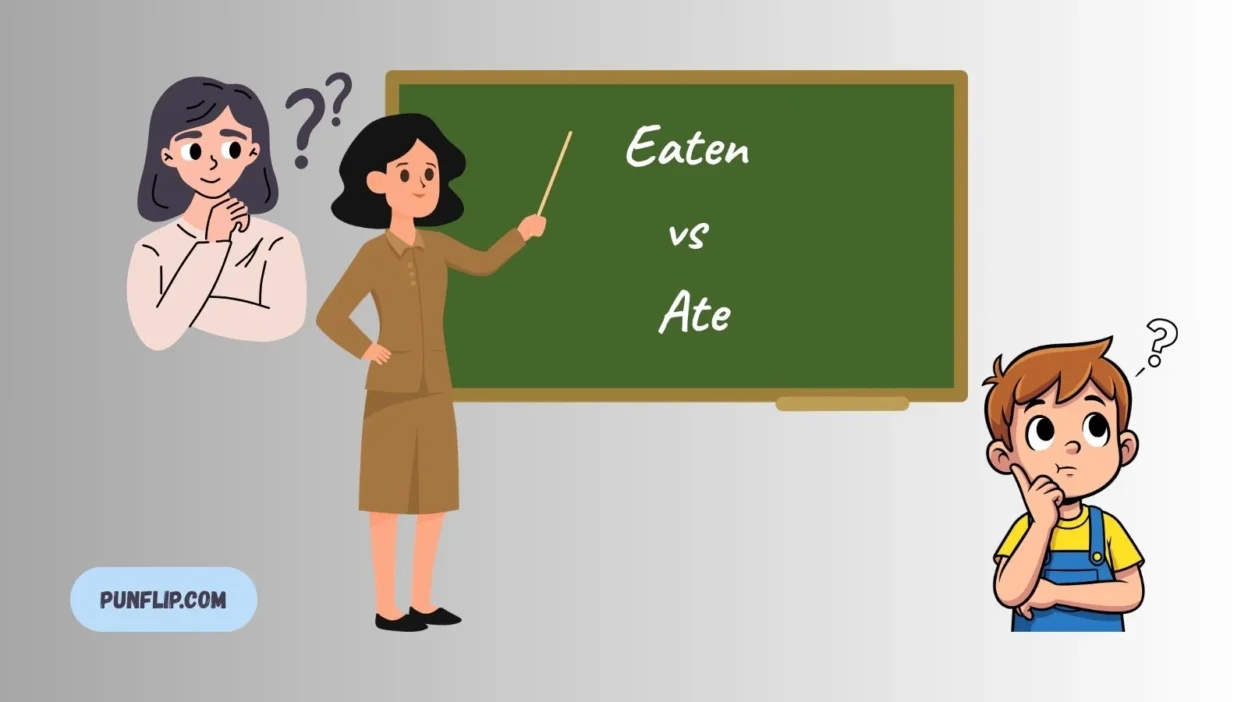
Choosing between eaten and ate can be confusing because both words come from the same verb, eat. They describe the action of consuming food, but they cannot always be used in the same sentence. Understanding the difference will help you write and speak English more naturally.
Whether you’re a student, English learner, content writer, or professional, mastering ate vs eaten is essential for clear communication. This guide explains the grammar rules, provides easy examples, highlights common mistakes, and shares memory tricks so you’ll never mix them up again.
Quick Answer
Ate is the simple past tense of eat and can stand alone in a sentence. Eaten is the past participle and must be used with a helping verb such as has, have, had, is, was, or been. Remember: I ate dinner is correct, while I have eaten dinner is also correct.
Why People Confuse It
Many English learners think ate and eaten mean exactly the same thing because both refer to something that happened in the past.
The confusion usually comes from:
- Both are forms of the verb eat.
- Both describe completed actions.
- Many irregular English verbs have different past tense and past participle forms.
- Learners often forget that eaten requires an auxiliary (helping) verb.
Understanding verb forms makes the difference much easier.
First Word: Ate
Ate is the simple past tense of the verb eat.
Use ate when talking about something that happened and finished in the past.
Structure
Subject + ate + object
Examples
- I ate breakfast at 7 a.m.
- She ate an apple yesterday.
- They ate together after work.
- We ate at a new restaurant.
- He ate too much cake.
Second Word: Eaten
Eaten is the past participle of eat.
It cannot be used alone. It must be paired with a helping verb.
Structure
- have/has + eaten
- had + eaten
- was/were + eaten (passive voice)
- has been + eaten
Examples
- I have eaten lunch.
- She has eaten already.
- They had eaten before we arrived.
- The cake was eaten quickly.
- All the cookies have been eaten.
Comparison Table
| Feature | Ate | Eaten |
| Verb Form | Simple past | Past participle |
| Can stand alone? | Yes | No |
| Needs helping verb? | No | Yes |
| Example | I ate lunch. | I have eaten lunch. |
| Common Tenses | Simple past | Present perfect, past perfect, passive voice |
| Grammar Role | Main verb | Participle |
When to Use Each
Choose ate when:
- Talking about a finished action in the past.
- Mentioning a specific past time.
- Writing in simple past tense.
Examples:
- We ate dinner last night.
- She ate before school.
- They ate pizza yesterday.
Choose eaten when:
- Using perfect tenses.
- Using passive voice.
- Describing an action completed before another action.
Examples:
- I have eaten enough.
- She had eaten before leaving.
- The meal was eaten by everyone.
Examples
Here are practical examples showing the correct use of both words.
- I ate breakfast early.
- She ate all the cookies.
- We ate together yesterday.
- They ate dinner at home.
- He ate too fast.
- I have eaten enough today.
- She has eaten already.
- They had eaten before the movie.
- The sandwich was eaten by the dog.
- All the fruit has been eaten.
- We have eaten here before.
- The leftovers had been eaten overnight.
Common Mistakes
Many learners make these errors:
❌ I have ate dinner.
✅ I have eaten dinner.
❌ She eaten lunch yesterday.
✅ She ate lunch yesterday.
❌ They had ate before arriving.
✅ They had eaten before arriving.
❌ He eaten an apple.
✅ He ate an apple.
Memory Trick
Think of this simple rule:
Ate works alone.
Eaten needs a helper.
If you see words like has, have, had, is, was, or been, then eaten is usually the correct choice.
If there’s no helping verb, use ate.
American vs British English
Both American English and British English follow the same grammar rules for ate and eaten.
Examples:
American English
- I ate lunch already.
- I have eaten lunch.
British English
- I ate lunch earlier.
- I have eaten lunch.
British English speakers often use the present perfect more frequently when discussing recent events.
Similar Words
Other irregular verbs follow the same pattern:
| Base Verb | Past | Past Participle |
| Eat | Ate | Eaten |
| Go | Went | Gone |
| Write | Wrote | Written |
| Speak | Spoke | Spoken |
| Break | Broke | Broken |
| See | Saw | Seen |
Learning these patterns makes English grammar much easier.
Final Verdict
The difference between ate and eaten is simple once you know their roles.
Use ate as the simple past tense for completed actions.
Use eaten as the past participle with helping verbs in perfect tenses and passive voice.
Whenever you’re unsure, check whether your sentence includes a helping verb. If it does, eaten is usually correct. If it doesn’t, ate is likely the right choice.
Frequently Asked Questions
Is “I have ate” correct?
No. The correct sentence is I have eaten because the present perfect requires the past participle.
Is “I ate” grammatically correct?
Yes. It is the correct simple past form of eat.
Can “eaten” be used without a helping verb?
No. Eaten always requires a helping verb such as has, have, or had.
Which is more common: ate or eaten?
Both are common, but they appear in different grammatical structures. Ate is common in simple past tense, while eaten appears in perfect tenses and passive constructions.
Why is “eaten” called a past participle?
Because it combines with auxiliary verbs to create perfect tenses and passive voice instead of functioning independently.
How do I remember the difference?
Remember this phrase:
Ate stands alone. Eaten needs a helper.
Conclusion
Learning the difference between ate and eaten is one of the most important steps toward improving your English grammar. Although both words describe eating, they serve different grammatical purposes. Ate is used for simple past actions, while eaten works with helping verbs to form perfect tenses and passive voice.
With regular practice, these forms become natural. Read English books, listen to native speakers, and create your own example sentences. Soon, choosing between ate and eaten will feel automatic, helping you write and speak with greater confidence.
Remember This
Eat → Ate → Eaten
- Ate = Simple past
- Eaten = Past participle
- Ate works alone.
- Eaten always needs a helping verb.
- Check for has, have, had, was, were, been before choosing eaten.

Roazi is a visionary thinker driven by creativity, innovation, and purpose. With a passion for excellence, he transforms bold ideas into meaningful realities.