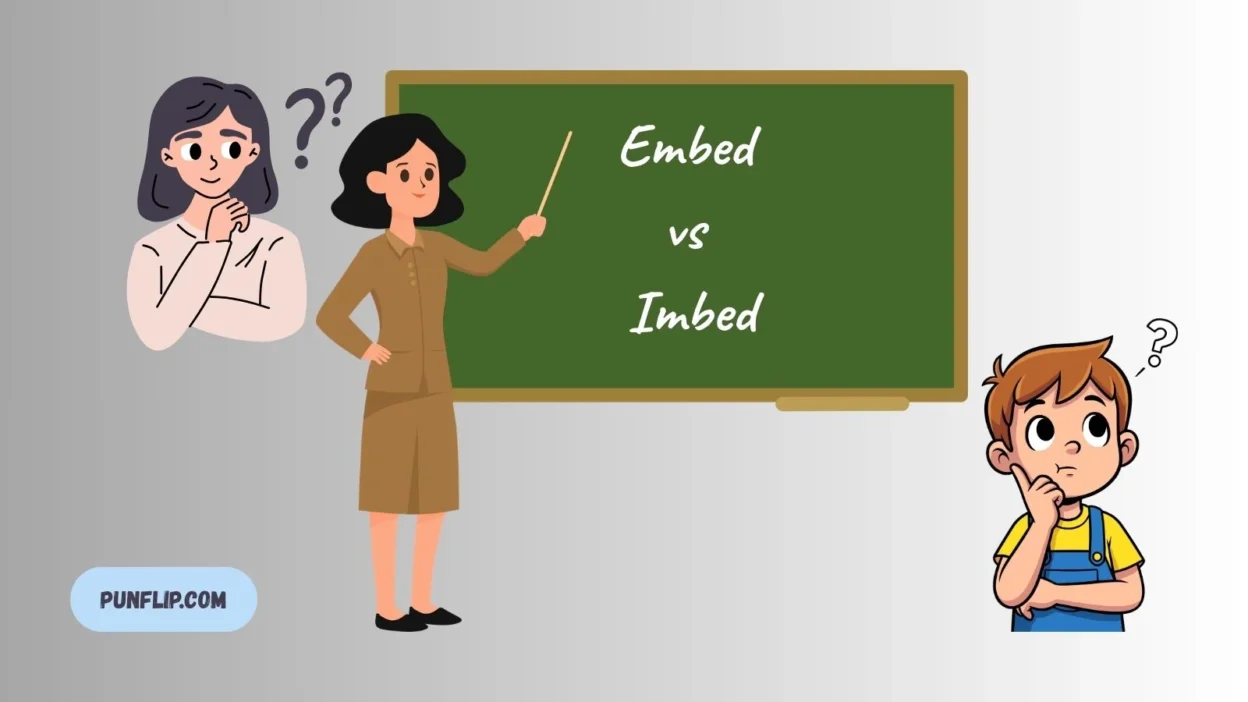
If you’ve ever wondered whether you should write embed or imbed, you’re not alone. These two spellings have confused English learners, students, writers, and even professionals for decades. Since both appear in dictionaries and published writing, it’s easy to assume they’re equally common. However, one spelling has clearly become the modern standard.
Understanding the difference between embed vs imbed is important for clear communication, academic writing, business documents, and digital content. Whether you’re embedding a video on a website, embedding data in software, or describing something firmly fixed in place, choosing the preferred spelling helps your writing look polished and professional. This guide explains the difference, shows when each word should be used, and provides practical examples for 2026.
Quick Answer
Embed is the preferred and standard spelling in modern English worldwide. Imbed is an older alternative spelling that is still recognized by major dictionaries but is much less common. In almost every situation—including academic, business, technology, and everyday writing—embed is the better choice.
Why People Confuse It
Many English words beginning with en- eventually developed em- forms before certain letters. Because of this historical language change, embed and imbed both entered English usage.
People become confused because:
- Both spellings appear in dictionaries.
- Older books sometimes use imbed.
- Spell checkers may recognize both.
- Both have exactly the same meaning.
- The pronunciation is identical.
Today, however, embed overwhelmingly dominates modern writing.
What Does “Embed” Mean?
Embed means to fix firmly within something, insert deeply, or integrate into another object or system.
It is commonly used in:
- Technology
- Education
- Journalism
- Engineering
- Medicine
- Construction
- Web development
Examples
- Please embed the video into the article.
- The reporter embedded herself with the military unit.
- Diamonds were embedded in the necklace.
- The company embedded security features into the software.
- The nail became embedded in the wood.
What Does “Imbed” Mean?
Imbed has exactly the same meaning as embed.
It is simply an older spelling that survives in some dictionaries and occasional publications.
Although grammatically correct, it appears far less often in modern English.
Examples
- The stone was imbedded in the wall.
- Doctors removed the imbedded object.
- Older novels may use imbed instead of embed.
Most style guides recommend replacing imbed with embed unless preserving historical text.
Embed vs Imbed Comparison Table
| Feature | Embed | Imbed |
| Modern standard spelling | ✅ Yes | ❌ No |
| Same meaning | ✅ Yes | ✅ Yes |
| Used in technology | ✅ Yes | Rare |
| Academic writing | ✅ Preferred | Rare |
| Business writing | ✅ Preferred | Rare |
| Dictionaries recognize it | ✅ Yes | ✅ Yes |
| Recommended for everyday writing | ✅ Yes | Usually No |
| Common in 2026 | ✅ Extremely common | Very uncommon |
When to Use Each
Use Embed when:
- Writing essays
- Creating websites
- Coding software
- Writing emails
- Publishing articles
- Creating business reports
- Writing academic papers
- Producing marketing content
Use Imbed when:
- Quoting historical documents.
- Preserving the original spelling of older texts.
- Referring to legacy publications that used the older form.
For nearly all modern writing, choose embed.
Examples
Here are practical examples showing correct usage.
- Please embed the image in the presentation.
- The website lets users embed YouTube videos.
- The engineer embedded sensors inside the device.
- Memories become deeply embedded over time.
- Tiny glass pieces were embedded in the tire.
- Teachers embed critical thinking into every lesson.
- The company embedded AI features into the software.
- Researchers embedded the chip beneath the surface.
- Good habits become embedded through practice.
- The designer embedded interactive maps on the webpage.
- The reporter was embedded with military forces.
- The jewel was embedded in gold.
Common Mistakes
Here are mistakes many writers make.
❌ The company imbedded the video on the homepage.
✅ The company embedded the video on the homepage.
❌ Modern websites usually imbed media.
✅ Modern websites usually embed media.
❌ Use imbed in professional business writing.
✅ Use embed in professional writing.
Memory Trick
Think of Embed as the spelling used by modern electronic media.
EMbed → Electronic Media
Since websites, apps, videos, and software almost always use embed, remembering EM for Electronic Media makes the preferred spelling easy to recall.
American vs British English
One interesting fact is that this isn’t really an American versus British spelling difference.
| Variety | Preferred Spelling |
| American English | Embed |
| British English | Embed |
| Canadian English | Embed |
| Australian English | Embed |
While imbed remains acceptable historically, embed is the dominant spelling across all major English varieties.
Similar Words
Words related to embed include:
- Insert
- Implant
- Fix
- Root
- Integrate
- Incorporate
- Ingrain
- Lodge
- Plant
- Set
- Attach
- Position
These words may fit different contexts depending on what you’re describing.
Final Verdict
If you’re choosing between embed and imbed in 2026, the answer is simple.
Choose embed.
Although imbed isn’t technically incorrect, it’s considered an older alternative spelling and appears much less frequently in modern English. Using embed keeps your writing current, professional, and consistent with major style guides, educational materials, and digital platforms.
Frequently Asked Questions
Is imbed incorrect?
No. It is an accepted alternative spelling, but it is much less common than embed.
Which spelling should students use?
Students should almost always use embed, as it is the preferred modern spelling.
Why do dictionaries include both?
Because both spellings have existed historically, dictionaries record both forms even though one is now far more common.
Is embed used in computer programming?
Yes. In technology, embed is the standard spelling for inserting media, code, fonts, videos, or data into another file or webpage.
Do Microsoft Word and Google Docs accept imbed?
Many spell checkers recognize imbed, but most writing recommendations still favor embed.
Is embedded correct?
Yes. Embedded is the standard past tense and adjective form used in modern English.
Is “embedded video” correct?
Yes. “Embedded video” is the standard phrase used in web development and digital publishing.
Conclusion
Choosing between embed and imbed is much easier once you understand their history. Both words mean exactly the same thing, but modern English overwhelmingly favors embed. It appears in newspapers, academic publications, software documentation, websites, and professional communication around the world.
Unless you’re quoting an older source or preserving historical spelling, embed should be your default choice. Using the standard spelling improves readability, matches current style guides, and ensures your writing meets modern expectations in 2026.
Remember This
Embed = Modern, standard, and recommended.
Imbed = Older alternative spelling that is still recognized but rarely preferred today.
When in doubt, always choose embed.