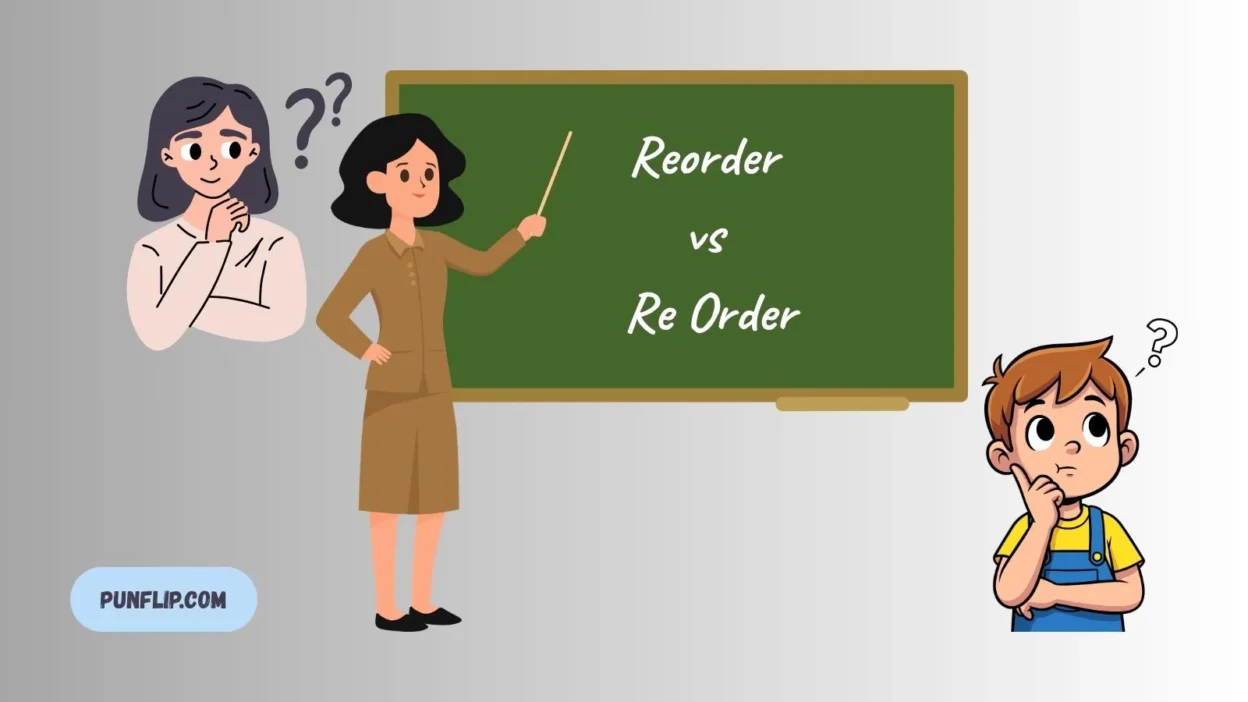
Have you ever wondered whether you should write reorder or re order? You’re not alone. This spelling question appears frequently in emails, online shopping, business communication, and academic writing. While both forms may seem logical, only one is considered the standard spelling in modern English in most situations.
Understanding the difference between reorder and re order helps you write more professionally and avoid common grammar mistakes. In this guide, you’ll learn the correct spelling, why people confuse these terms, when exceptions exist, and how to remember the right choice. Whether you’re a student, writer, teacher, or professional, this 2026 grammar guide will help you use the word with confidence.
Quick Answer
Reorder is the standard and correct spelling in modern English. It means to order again or arrange differently. Re order is generally incorrect as two separate words unless re is being used independently in a very specific context, which is rare in everyday English.
Why People Confuse It
Many English learners separate re from the base word because they recognize re- as a prefix meaning “again.
The confusion also comes from seeing hyphenated forms such as re enter or re examine, making people wonder if re order should also be separated.
In standard English, however, reorder is written as one word because the prefix joins directly with order.
Reorder
Reorder is a verb that means:
- To order something again.
- To arrange something in a different sequence.
It is the accepted spelling in dictionaries and style guides.
Examples
- I need to reorder printer paper.
- Please reorder the slides before the presentation.
- Customers can reorder previous purchases with one click.
- We must reorder the paragraphs for better flow.
Re Order
Re order as two separate words is generally not considered standard English.
It may occasionally appear when re is used independently in legal references, editorial notes, or quoted material, but these situations are uncommon.
For normal writing, avoid separating the prefix from order.
Rare Example
- The lawyer discussed the matter re: Order No. 458.
Notice that here re means regarding, not again.
Comparison Table
| Feature | Reorder | Re Order |
| Standard English | ✅ Yes | ❌ Usually No |
| Dictionary Entry | ✅ Yes | ❌ No |
| Means “order again” | ✅ Yes | ❌ No |
| Means “arrange differently” | ✅ Yes | ❌ No |
| Business Writing | ✅ Recommended | ❌ Avoid |
| Academic Writing | ✅ Recommended | ❌ Avoid |
When to Use Each
Use reorder when you mean:
- Ordering a product again
- Rearranging items
- Changing sequence
- Organizing information differently
Avoid re order unless re stands separately with its own meaning, such as regarding in legal or formal references.
Examples
Here are practical examples using the correct form.
- I need to reorder my prescription.
- She decided to reorder the chapters.
- Please reorder these files alphabetically.
- Customers can reorder previous purchases online.
- We should reorder the meeting agenda.
- The teacher asked students to reorder the sentences.
- I’ll reorder the office supplies tomorrow.
- The designer chose to reorder the images.
- You can reorder food through the app.
- They had to reorder inventory after the sale.
- We need to reorder our priorities.
- The editor decided to reorder several paragraphs.
Common Mistakes
People often make these errors:
- ❌ I will re order the book.
- ✅ I will reorder the book.
- ❌ Please re order these documents.
- ✅ Please reorder these documents.
- ❌ Can you re order lunch?
- ✅ Can you reorder lunch?
Memory Trick
Think of re- as a permanent prefix that usually sticks to the beginning of common verbs.
If the word means “again,” it’s usually written as one word.
Again + Order = Reorder
This simple rule works in almost every everyday writing situation.
American vs British English
Both American English and British English use reorder as the preferred spelling.
There is no meaningful regional difference between the two varieties of English for this word.
Whether you’re writing for the US, UK, Canada, Australia, or other English speaking countries, reorder is the recommended form.
Similar Words
Other words that follow the same pattern include:
- Rebuild
- Rewrite
- Repaint
- Reprint
- Reorganize
- Reinstall
- Reconnect
- Recalculate
- Reconsider
- Rearrange
These words also combine the re- prefix with the base word instead of separating them.
Final Verdict
For nearly every writing situation, reorder is the correct spelling.
Use it when referring to ordering something again or arranging something differently. Avoid re order because it is not accepted in standard modern English except in rare contexts where re has a separate meaning.
Choosing reorder makes your writing clearer, more professional, and grammatically correct.
Frequently Asked Questions
Is reorder one word or two?
Reorder is one word and is the standard spelling in modern English.
Is re order grammatically correct?
Generally, no. It should almost always be written as reorder.
Does reorder mean order again?
Yes. It commonly means ordering something again or arranging items differently.
Is reorder acceptable in academic writing?
Yes. Academic, professional, and business writing all use reorder.
Is reorder correct in British English?
Yes. British English also prefers reorder.
Why do some people write re order?
They mistakenly separate the re- prefix from the base word or confuse it with words that sometimes use hyphens.
Should I use a hyphen like re order?
Modern dictionaries generally prefer reorder without a hyphen unless a publisher’s style guide specifies otherwise.
Conclusion
Choosing between reorder and re order is easier once you understand how English prefixes work. In modern English, reorder is the accepted spelling because the prefix re- combines directly with order to create a single word. This applies whether you’re talking about purchasing an item again or changing the arrangement of something.
Using the correct spelling improves clarity and makes your writing look more polished. Whether you’re sending business emails, writing school assignments, creating website content, or publishing professional documents, using reorder will keep your English accurate and natural.
Remember This
Remember: If you mean “order again” or “arrange again,” always write reorder as one word. Separate re only when it has its own independent meaning, which is uncommon in everyday English.

Christopher Matthew is a visionary leader driven by creativity, innovation, and purpose. He turns ideas into impact through passion, persistence, and a deep commitment to excellence.