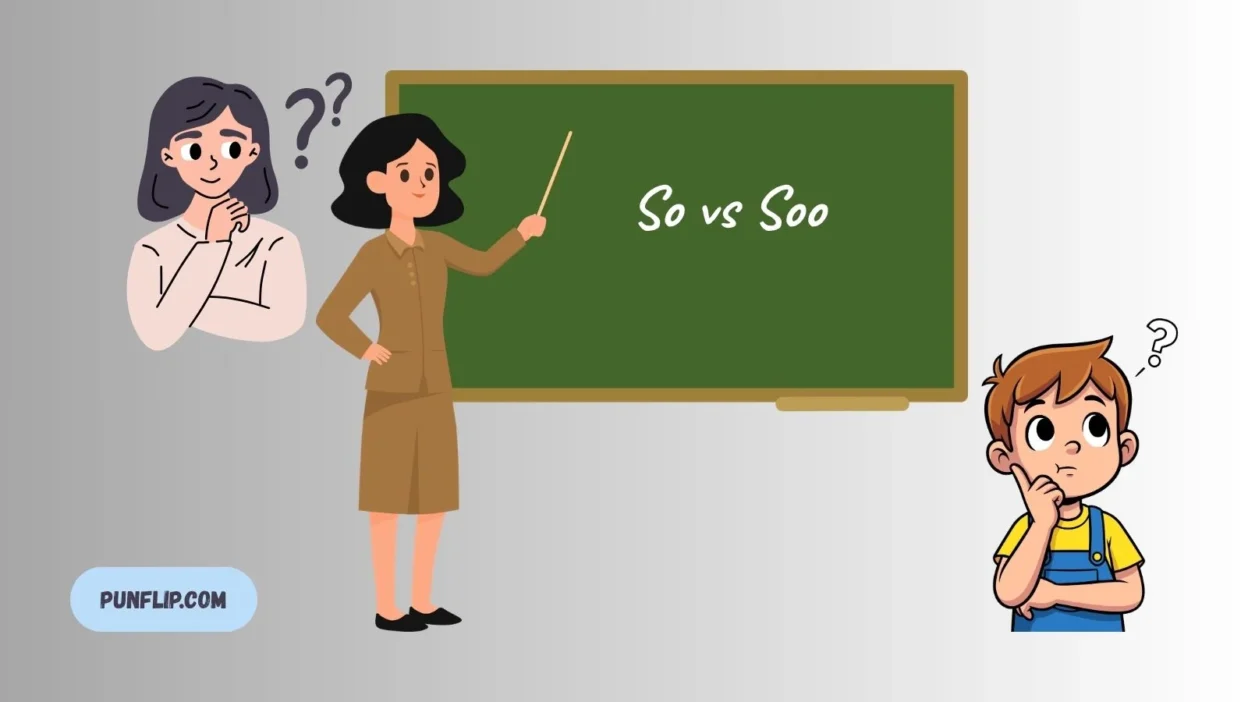
Have you ever wondered whether you should write so or soo? You’re not alone. Many English learners and even native speakers occasionally see soo in text messages, social media posts, or online comments and wonder if it’s a proper English word. Because informal internet language has become so common, it’s easy to confuse standard spelling with creative online expressions.
The good news is that the difference is simple. In standard English grammar, so is the correct spelling, while soo is generally an intentional misspelling used to add emphasis in casual digital conversations. Understanding when each form is appropriate will help you write more confidently in emails, school assignments, business communication, and social media.
Quick Answer
So is the correct English word used to express degree, agreement, reason, or emphasis. Soo is not a standard English word. It is an informal internet spelling used mainly in texting or social media to exaggerate emotion or emphasis. Use so in all formal and professional writing.
Why People Confuse It
The confusion comes from modern digital communication.
People often stretch words online to show excitement or emotion. Just as someone might write “nooo,” “pleeease,” or “yesss,” many people write soo instead of so for dramatic effect.
Since this spelling appears frequently on social media, some learners mistakenly assume it’s an accepted English word.
So
So is a standard English word with several important meanings.
It can function as:
- An adverb
- A conjunction
- An intensifier
- A pronoun in some expressions
Examples
- She is so kind.
- I was so tired yesterday.
- It was raining, so we stayed inside.
- I think so.
- Why are you so happy?
In every formal situation, so is the correct spelling.
Soo
Soo is not recognized as a standard English word.
Instead, it is an informal spelling people use online to express stronger emotion or exaggeration.
Examples include:
- I’m soo excited!
- That’s soo funny!
- You’re soo sweet.
Although these examples are common on social media, they should not appear in academic papers, business emails, professional writing, or exams.
Comparison Table
| Feature | So | Soo |
| Standard English | ✅ Yes | ❌ No |
| Dictionary word | ✅ Yes | ❌ No |
| Formal writing | ✅ Yes | ❌ Never |
| Academic writing | ✅ Yes | ❌ No |
| Business communication | ✅ Yes | ❌ No |
| Social media | ✅ Yes | ✅ Sometimes |
| Text messages | ✅ Yes | ✅ Informal emphasis |
| Grammar correct | ✅ Yes | ❌ Generally no |
When to Use Each
Use So when:
- Writing essays
- Sending emails
- Creating reports
- Writing blogs
- Taking exams
- Speaking professionally
- Giving presentations
- Following proper grammar
Use Soo only when:
- Texting close friends
- Posting casually on social media
- Showing excitement
- Adding dramatic emphasis
- Writing humorous content
Avoid using soo in professional communication.
Examples
Here are examples showing correct usage.
- She is so talented.
- I am so grateful for your help.
- It became cold, so we went inside.
- The movie was so interesting.
- I’m so proud of you.
- Why are you so quiet today?
- I don’t think so.
- Thank you so much.
- That dress looks so beautiful.
- We were so excited about the trip.
- I’m soo happy! (informal texting only)
- You’re soo funny! (casual online writing)
Common Mistakes
Many learners make these errors:
- Writing soo in school assignments.
- Using soo in job applications.
- Thinking soo is listed in dictionaries.
- Replacing every instance of so with soo.
- Assuming social media spelling is grammatically correct.
Always remember that so is the accepted English spelling.
Memory Trick
Here’s an easy way to remember the difference:
One “o” = Official English.
Two “o”s = Online expression.
If you’re writing something important, use so.
American vs British English
There is no difference between American and British English regarding this word.
Both varieties use so as the correct spelling.
Likewise, soo remains an informal internet spelling rather than a standard word in either version of English.
Similar Words
Words that learners often confuse with so include:
- Very
- Such
- Too
- Also
- Therefore
- Thus
- Hence
- Really
- Quite
- Extremely
Each has a different meaning depending on context, so choose carefully.
Final Verdict
The answer is straightforward.
So is the correct English word for formal, academic, and everyday writing.
Soo is simply an informal internet variation used to add emotion in casual conversations. While it’s perfectly acceptable among friends online, it should never replace so in professional or educational writing.
Frequently Asked Questions
Is soo a real English word?
No. Soo is not a standard English word. It is an informal spelling used online for emphasis.
Should I write so or soo in an essay?
Always use so in essays, reports, and academic writing.
Is soo grammatically correct?
Not in formal English. It is considered an informal stylistic spelling.
Why do people write soo?
People use soo to express stronger emotion, excitement, or exaggeration in casual messages.
Can I use soo in business emails?
No. Business communication should always use the correct spelling: so.
Is soo acceptable on social media?
Yes, in casual conversations. However, it remains an informal expression rather than standard English.
Conclusion
Although so and soo may look similar, they serve different purposes. So is the correct, dictionary approved English word used in everyday communication, academic writing, and professional settings. It performs several grammatical functions and appears naturally in nearly every type of English writing.
Meanwhile, soo belongs to informal internet culture. It helps writers express excitement, affection, or emphasis in text messages and social media posts but should stay out of formal writing. Knowing the difference will improve your grammar, strengthen your writing, and help you communicate with confidence.
Remember This
Use “so” whenever correctness matters. Save “soo” for casual texting and social media if you want extra emphasis but never in formal English.

Christopher Matthew is a visionary leader driven by creativity, innovation, and purpose. He turns ideas into impact through passion, persistence, and a deep commitment to excellence.