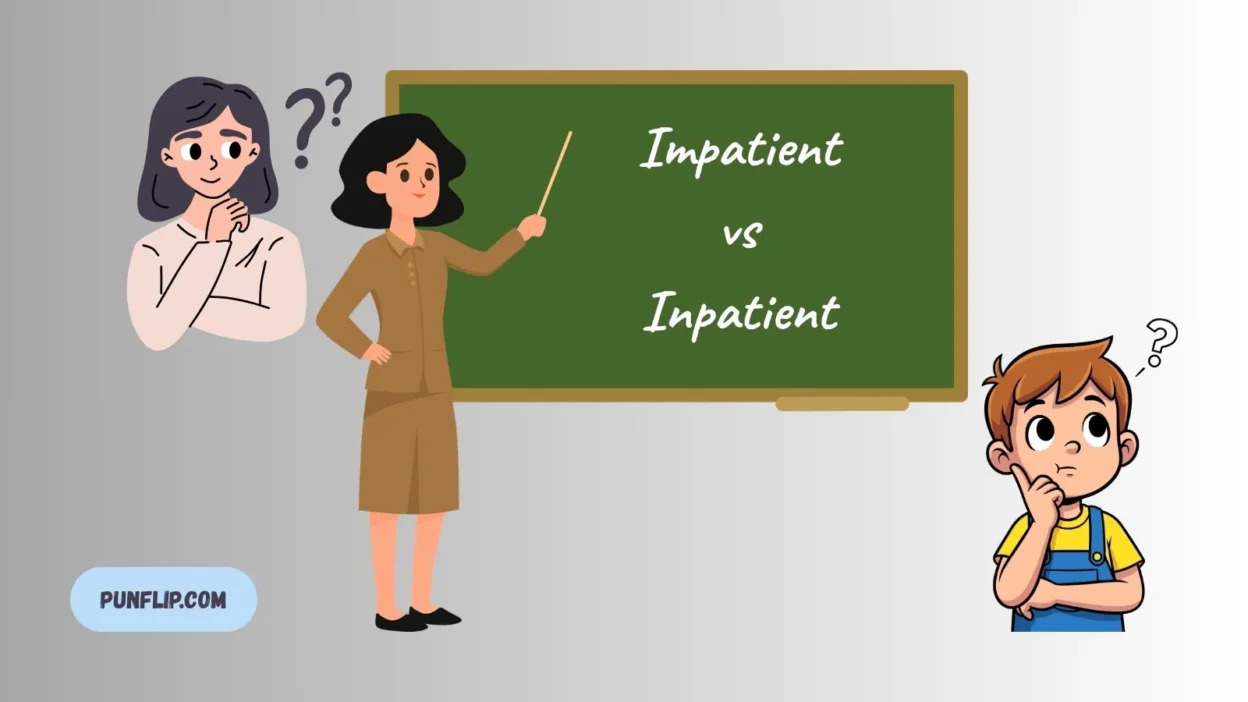
English has many word pairs that look almost identical but have completely different meanings. Impatient and inpatient are a perfect example. They differ by only one letter, yet confusing them can completely change the meaning of your sentence. One describes a person’s attitude, while the other refers to someone receiving medical care in a hospital.
If you’ve ever wondered whether to write impatient or inpatient, you’re in the right place. This guide explains both words in simple English with clear definitions, practical examples, memory tricks, and a comparison table. Whether you’re a student, ESL learner, writer, or professional, you’ll leave knowing exactly when to use each word confidently.
Quick Answer
Impatient is an adjective that describes someone who cannot wait calmly or becomes annoyed by delays.
Inpatient is a noun or adjective used in healthcare for a person who stays in a hospital for treatment instead of going home the same day.
Example:
- The children became impatient while waiting for the bus.
- The doctor admitted the patient as an inpatient after surgery.
Why People Confuse It
Many people mix up impatient and inpatient because:
- They differ by only one letter.
- They are pronounced somewhat similarly.
- Spell check may not catch the mistake because both are real English words.
- One is common in everyday conversation, while the other is mostly used in medical settings.
- Fast typing often causes people to omit or insert spaces incorrectly.
Understanding their meanings makes the difference easy to remember.
What Does Impatient Mean?
Impatient is an adjective describing someone who becomes annoyed, restless, or frustrated because something is taking too long.
Meaning
Someone who doesn’t like waiting.
Examples
- She became impatient during the long meeting.
- The customers grew impatient after waiting for an hour.
- Don’t be impatient; your turn is coming.
- He looked impatient while standing in line.
- Children often become impatient before holidays.
Common LSI Keywords
- unable to wait
- restless
- annoyed
- frustrated
- eager
- lacking patience
What Does Inpatient Mean?
Inpatient refers to a person who stays in a hospital overnight or for several days to receive medical treatment.
It can be used as:
- a noun (the patient)
- an adjective (inpatient care)
Examples
- She remained an inpatient for three days.
- The hospital admitted him as an inpatient.
- Inpatient treatment is recommended after surgery.
- The nurse checked every inpatient in the ward.
- Some conditions require inpatient observation.
Common LSI Keywords
- hospital patient
- admitted patient
- inpatient care
- hospital stay
- medical treatment
- healthcare
Impatient vs Inpatient Comparison Table
| Feature | Impatient | Inpatient |
| Part of Speech | Adjective | Noun or adjective |
| Meaning | Unable to wait calmly | Hospital patient staying overnight |
| Used In | Everyday conversations | Medical and healthcare settings |
| Describes | A person’s behavior | A patient’s treatment status |
| Example | She is impatient. | He is an inpatient. |
When to Use Each
Use Impatient when:
- Someone is annoyed by waiting.
- Describing emotions.
- Talking about behavior.
- Discussing delays or frustration.
Examples
- I’m getting impatient.
- They were impatient with the slow service.
- The audience became impatient.
Use Inpatient when:
- Talking about hospitals.
- Referring to overnight medical care.
- Discussing healthcare services.
- Mentioning hospital admission.
Examples
- She became an inpatient after the accident.
- The doctor recommended inpatient rehabilitation.
- Every inpatient received medication.
Examples
Here are more examples showing both words correctly.
Impatient
- I became impatient after waiting for 40 minutes.
- The teacher told the students not to be impatient.
- She sounded impatient on the phone.
- The baby grew impatient before feeding time.
- He was impatient to hear the results.
- We became impatient because the train was late.
Inpatient
- The surgeon admitted her as an inpatient.
- Every inpatient received a private room.
- The hospital expanded its inpatient services.
- He spent five days as an inpatient.
- Inpatient rehabilitation helped him recover faster.
- The doctor transferred the inpatient to another ward.
Common Mistakes
❌ Incorrect:
I became inpatient while waiting.
✅ Correct:
I became impatient while waiting.
❌ Incorrect:
She is an impatient at the hospital.
✅ Correct:
She is an inpatient at the hospital.
❌ Incorrect:
The children were inpatient during the delay.
✅ Correct:
The children were impatient during the delay.
❌ Incorrect:
The hospital offers impatient care.
✅ Correct:
The hospital offers inpatient care.
Memory Trick
Here’s an easy way to remember the difference:
Impatient = “I’m tired of waiting.”
Think of impatient as someone who cannot wait.
Inpatient = “In the hospital.”
The word starts with in, reminding you that the patient is in the hospital.
American vs British English
Both American English and British English use impatient and inpatient with the same meanings.
The only minor difference is that healthcare terminology may vary slightly between countries, but inpatient is universally understood in English speaking healthcare systems.
Similar Words
You may also confuse these words with:
- patient
- outpatient
- patience
- restless
- tolerant
- hospital patient
- frustrated
- eager
- clinic patient
Learning these related words helps improve your English vocabulary and writing accuracy.
Final Verdict
Although impatient and inpatient look very similar, they belong to completely different contexts.
Choose impatient when describing someone’s inability to wait calmly.
Choose inpatient when referring to a hospital patient who stays overnight or receives hospital based treatment.
Remember that a single missing letter can completely change your sentence’s meaning, so always check which context you’re writing about.
Frequently Asked Questions (FAQs)
1. Is impatient the opposite of patient?
Yes. Impatient means lacking patience or becoming annoyed while waiting.
2. What does inpatient mean in healthcare?
An inpatient is someone admitted to a hospital for treatment and stays at least one night.
3. Can inpatient be an adjective?
Yes. For example:
Inpatient care and inpatient treatment.
4. Which word refers to waiting?
Impatient relates to waiting or becoming frustrated because of delays.
5. Is an outpatient the same as an inpatient?
No. An outpatient receives treatment without staying overnight, while an inpatient stays in the hospital.
6. Why are impatient and inpatient often confused?
They have nearly identical spelling and pronunciation, but their meanings are completely unrelated.
7. Can I say “I am inpatient”?
Only if you mean you are admitted to a hospital. If you mean you dislike waiting, say I am impatient.
Conclusion
The difference between impatient and inpatient is simple once you connect each word to its context. Impatient belongs to everyday conversations about emotions, frustration, and waiting. Inpatient belongs to hospitals and healthcare, referring to people who stay in a medical facility for treatment.
Whenever you’re unsure, ask yourself one question: Am I talking about waiting or about a hospital? If it’s about waiting, choose impatient. If it’s about medical care and staying in a hospital, choose inpatient. With this simple rule, you’ll avoid one of the most common English spelling mix ups.
Remember This
Impatient = Can’t wait.
Inpatient = In the hospital.
One describes behavior; the other describes medical care.

Christopher Matthew is a visionary leader driven by creativity, innovation, and purpose. He turns ideas into impact through passion, persistence, and a deep commitment to excellence.