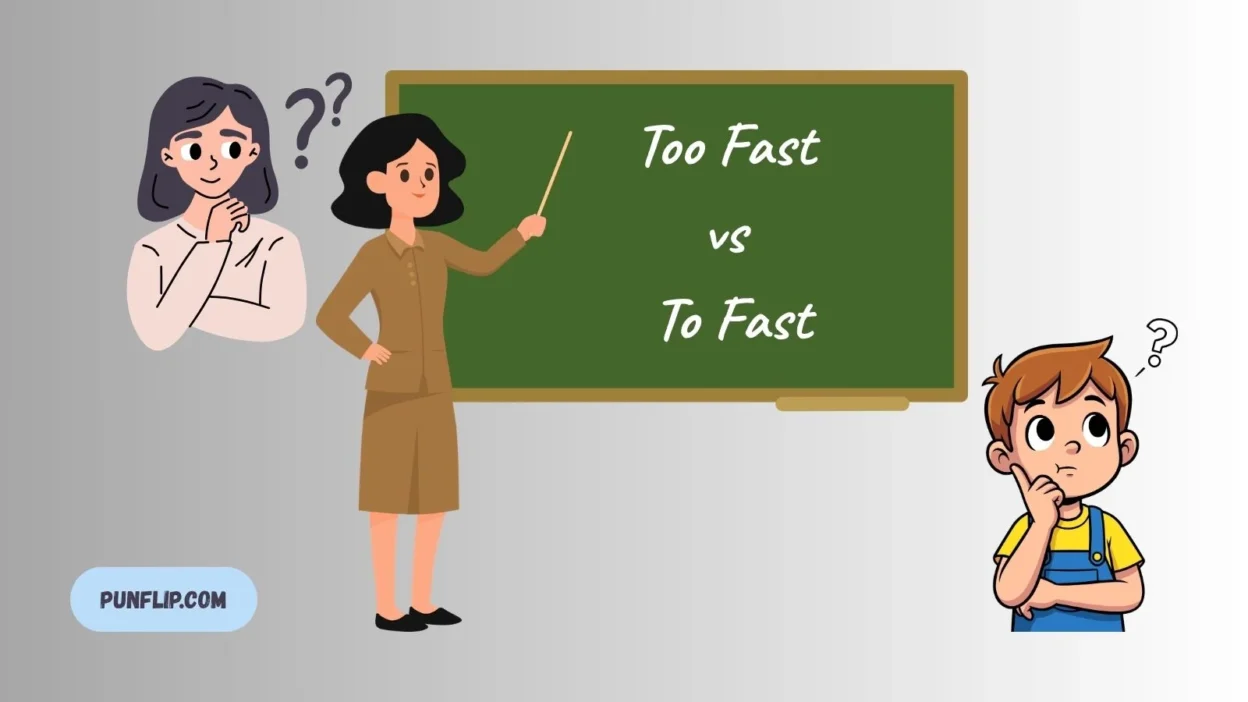
Have you ever paused while writing because you weren’t sure whether to use too fast or to fast? You’re not alone. This is one of the most common grammar mistakes made by English learners, students, and even native speakers who type quickly. Since to and too sound exactly the same, it’s easy to confuse them.
The good news is that the difference is actually very simple once you understand the job each word does in a sentence. In this guide, you’ll learn when to use too fast, why to fast is usually incorrect, and how to avoid making this mistake in everyday writing. By the end, you’ll know the rule well enough to use it confidently in emails, essays, conversations, and exams.
Quick Answer
Too fast is the correct phrase when you mean excessively fast or faster than is appropriate.
To fast is usually incorrect because to is a preposition or part of an infinitive, while fast is generally an adjective or adverb. Only in rare situations, where fast is used as a verb (which is uncommon), could to fast be grammatically possible.
Correct: She was driving too fast.
Incorrect: She was driving to fast.
Why People Confuse It
The confusion happens because to and too are homophones. They sound exactly alike but have completely different meanings.
People often make this mistake because:
- They type quickly.
- Spell check sometimes misses it.
- Both words have only one extra letter.
- English pronunciation doesn’t distinguish between them.
- Beginners memorize pronunciation before grammar.
Once you learn what too means, the mistake becomes much easier to avoid.
First Word: “Too”
Too means:
- More than necessary
- More than expected
- Excessively
- Also (in a different context)
When too comes before an adjective or adverb, it means more than is good or acceptable.
Examples:
- The coffee is too hot.
- He speaks too loudly.
- The movie was too long.
- She walked too fast.
- You’re working too hard.
In too fast, the word too means excessively.
Second Word: “To”
To has several grammatical jobs.
It can:
- Show direction
- Connect a verb in its infinitive form
- Introduce a destination
- Express purpose
Examples:
- Go to school.
- I want to eat.
- She went to London.
- It’s time to leave.
- They came to help.
Notice that to does not mean excessively. That’s why writing to fast instead of too fast is usually wrong.
Comparison Table
| Feature | Too Fast | To Fast |
| Correct in normal English? | ✅ Yes | ❌ Usually No |
| Meaning | Excessively fast | Usually a spelling mistake |
| Part of speech | Adverb + adjective/adverb | Preposition or infinitive marker |
| Common in everyday writing | Very common | Rare |
| Example | The car was too fast. | Incorrect in this sentence |
When to Use Each
Use Too Fast When:
You want to describe something happening at an excessive speed.
Examples:
- The train was moving too fast.
- You’re talking too fast.
- The game ended too fast.
- I finished the book too fast.
- He spends money too fast.
Use To Fast When:
In modern English, to fast is extremely uncommon. It only appears when fast is functioning as a verb meaning to abstain from food.
Examples:
- Some people choose to fast during religious holidays.
- Doctors sometimes recommend patients to fast before surgery (although “be told to fast” is more common).
Notice that this meaning has nothing to do with speed.
Examples
Here are everyday examples showing the correct usage.
- She was driving too fast.
- You’re speaking too fast for me to understand.
- The internet connection is too fast for my old computer.
- He answered too fast without thinking.
- We walked too fast and became tired.
- The children ran too fast.
- The movie moved too fast for younger viewers.
- I read the instructions too fast and missed an important detail.
- The horse was running too fast around the corner.
- The teacher explained the lesson too fast.
- Don’t type too fast if you want fewer mistakes.
- She finished the race too fast and lost energy early.
Examples where to fast is correct:
- Muslims may choose to fast during Ramadan.
- Patients are often instructed to fast before certain medical tests.
Common Mistakes
Many learners accidentally write:
❌ He was running to fast.
✅ He was running too fast.
❌ You drive to fast.
✅ You drive too fast.
❌ I speak to fast.
✅ I speak too fast.
Remember that whenever you mean more than necessary, you need too, not to.
Memory Trick
Here’s an easy way to remember it:
Too has an extra “o.”
Think of that extra letter as meaning extra amount.
- Too = extra
- Too fast = extra fast
If you’re talking about more than enough speed, choose too.
American vs British English
There is no difference between American and British English for this grammar rule.
Both varieties use:
- too fast ✅
- to fast ❌ (unless referring to fasting)
Whether you’re writing for an American or British audience, the rule remains exactly the same.
Similar Words
These word pairs cause similar confusion:
- Too vs To
- Two vs Too
- Than vs Then
- Your vs You’re
- Its vs It’s
- Affect vs Effect
- Accept vs Except
- Lose vs Loose
Learning these pairs will greatly improve your English writing accuracy.
Final Verdict
If you’re talking about speed, the correct phrase is almost always too fast.
Use too because it means excessively or more than necessary.
Reserve to fast only for the rare situation where fast is a verb meaning to avoid eating food.
Whenever you mean someone is moving, speaking, driving, reading, or working at excessive speed, write too fast.
Frequently Asked Questions
Is “to fast” ever correct?
Yes, but only when fast is used as a verb meaning to avoid eating, such as “to fast before surgery.”
Which is correct: “too fast” or “to fast”?
If you’re talking about speed, too fast is correct.
Why do people confuse “to” and “too”?
Because they sound exactly the same in spoken English.
Does “too” always mean “very”?
Not exactly. It means more than necessary or excessively, not simply “very.”
Is “too fast” grammatically correct?
Yes. It is completely correct and commonly used.
Can spell check catch this mistake?
Not always. Since to is a correctly spelled word, grammar checking is often needed.
Is the rule different in British English?
No. American and British English follow the same rule.
Remember This
If you mean “excessively fast,” always write too fast.
Think of the extra O in too as standing for extra speed. If you’re describing someone moving, driving, speaking, or working faster than they should, too fast is the correct choice every time.
Conclusion
Understanding the difference between too fast and to fast is much easier than it first appears. The phrase too fast is the standard expression used to describe something happening at an excessive speed, while to fast is only correct in the uncommon situation where fast functions as a verb meaning to abstain from food.
The next time you’re writing an email, completing homework, publishing content, or chatting online, remember this simple rule: if you’re talking about speed, use too fast. A single extra letter makes all the difference, and mastering this small grammar point will help make your English clearer, more accurate, and more professional.