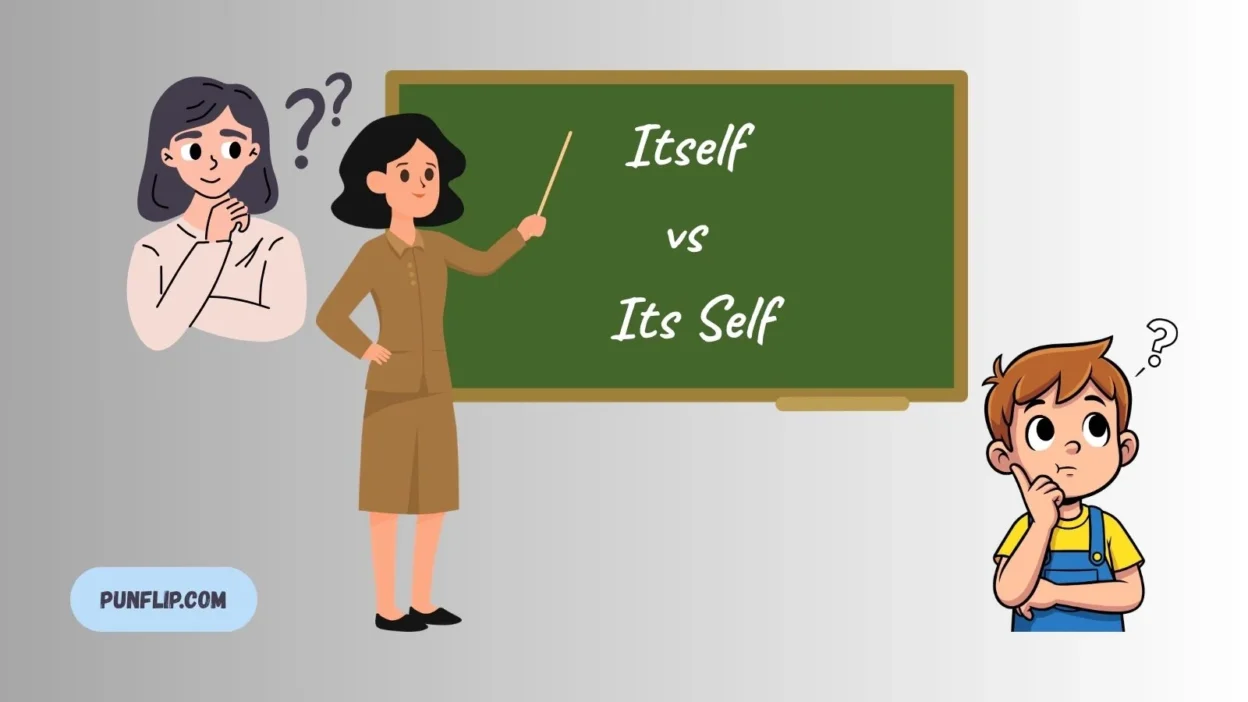
Many English learners become confused when they see itself and its self because both appear to contain the same words. At first glance, they may seem interchangeable, but they are not used in the same way. In modern English, one form is correct almost all the time, while the other appears only in rare, specialized contexts.
If you’ve ever wondered whether to write the cat cleaned itself or the cat cleaned its self, you’re in the right place. This guide explains the difference in clear, simple language with practical examples, common mistakes, and memory tips. By the end, you’ll know exactly when to use itself and why its self is usually incorrect in everyday writing.
Quick Answer
Itself is the standard reflexive pronoun used in modern English. It refers back to a thing, animal, organization, or idea that is the subject of the sentence. Its self is not normally correct in everyday English. It appears only in rare philosophical, psychological, or literary discussions where self is used as a separate noun.
Why People Confuse It
People often confuse itself and its self because himself, herself, and yourself are all written as one word. Since its is already a possessive form, some writers mistakenly separate self and create its self.
Other reasons include:
- Both contain the same letters.
- Spell checkers may not always explain the difference.
- Some older books and philosophical writings use its self intentionally.
- Learners assume every pronoun follows the same spelling pattern without knowing the grammatical rule.
The good news is that the correct choice is simple for almost every situation.
First Word: Itself
Itself is a reflexive pronoun. It refers back to the subject of the sentence.
Uses of itself
- Shows that something acts upon itself.
- Adds emphasis.
- Refers to animals, objects, machines, organizations, ideas, or situations.
Examples
- The dog scratched itself.
- The machine shut itself down.
- The company reinvented itself.
- The door opened by itself.
- Nature heals itself over time.
In modern English, itself is the correct form in almost every normal sentence.
Second Word: Its Self
Its self is a combination of:
- its (possessive adjective)
- self (noun)
Unlike itself, these two words do not form a reflexive pronoun.
This form is mainly found in:
- philosophy
- psychology
- literary analysis
- discussions about identity or consciousness
Rare Examples
- The AI questioned its self as an independent identity.
- The organism distinguished its self from its environment.
Even in these contexts, many modern writers still prefer itself unless discussing the concept of the self as a noun.
Comparison Table
| Feature | Itself | Its Self |
| Part of speech | Reflexive pronoun | Possessive adjective + noun |
| Common in modern English | Yes | Very rare |
| Used in everyday writing | Yes | No |
| Used for emphasis | Yes | No |
| Used in philosophy or identity discussions | Sometimes | Yes |
| Recommended for students | Yes | Usually no |
When to Use Each
Use itself when:
- Something performs an action on itself.
- You need a reflexive pronoun.
- Writing school assignments.
- Writing emails or professional documents.
- Speaking everyday English.
Example:
- The computer restarted itself.
Use its self only when:
- Discussing identity or consciousness.
- Writing philosophical or academic material where self is treated as a separate noun.
- Quoting older texts that use this spelling.
Example:
- The creature became aware of its self.
Examples
Here are practical examples to help you remember.
Correct
- The cat cleaned itself.
- The phone switched itself off.
- The plant protects itself from insects.
- The robot repaired itself.
- The company transformed itself after the merger.
- The city rebuilt itself after the storm.
- The engine cooled itself automatically.
- The software updated itself overnight.
- The child watched the toy move by itself.
- The organization rebranded itself.
- The wound healed itself naturally.
- The universe expands by itself.
Rare Specialized Example
- The philosopher explored how the machine understands its self.
Common Mistakes
❌ The dog hurt its self.
✅ The dog hurt itself.
❌ The phone turned its self off.
✅ The phone turned itself off.
❌ The company introduced its self.
✅ The company introduced itself.
❌ The machine fixed its self.
✅ The machine fixed itself.
Memory Trick
Remember this simple rule:
If you mean “on its own,” always write “itself” as one word.
Only separate the words if self is literally being used as a noun discussing identity.
Think of these patterns:
- himself ✅
- herself ✅
- yourself ✅
- itself ✅
Notice they are all written as one word.
American vs British English
There is no difference between American and British English for normal usage.
Both varieties use itself as the standard reflexive pronoun.
The separated form its self appears only in rare academic, philosophical, or literary writing in both forms of English.
Similar Words
These words follow the same pattern:
- myself
- yourself
- yourselves
- himself
- herself
- ourselves
- themselves
- oneself
All of these reflexive pronouns are written as one word.
Final Verdict
For nearly every sentence you write, itself is the correct choice.
Use its self only in unusual discussions where self functions as an independent noun referring to identity or consciousness. If you’re writing essays, emails, blog posts, exams, or professional content, choose itself without hesitation.
Learning this distinction helps improve grammar, writing accuracy, and confidence in English.
Frequently Asked Questions
1. Is “its self” grammatically correct?
Only in rare philosophical or literary contexts where self is a separate noun. It is not correct for everyday English.
2. Which form should students use?
Students should almost always use itself.
3. Why is “itself” one word?
Because it is a standard English reflexive pronoun, just like himself and herself.
4. Can I say “The machine fixed its self”?
No. The correct sentence is:
The machine fixed itself.
5. Do American and British English use different spellings?
No. Both use itself in ordinary writing.
6. Is “itself” a pronoun?
Yes. It is a reflexive pronoun.
7. Does “its self” appear in dictionaries?
Some dictionaries acknowledge it as a rare historical or philosophical usage, but it is not the standard choice for everyday English.
Remember This
✔ Everyday English → itself
✔ Reflexive pronoun → itself
✔ Exams and professional writing → itself
✔ Rare discussions about identity → its self (only when “self” is a separate noun)
When in doubt, write itself.
Conclusion
Understanding the difference between itself and its self is easier than it first appears. Although both forms contain the same words, they serve different grammatical purposes. Itself is the standard reflexive pronoun used in everyday English, while its self is a rare construction reserved for specialized discussions about identity, philosophy, or consciousness.
For students, professionals, and anyone aiming to write clear, correct English, the safest choice is almost always itself. Remember the simple rule: if something acts on its own or refers back to the subject, use itself as one word. Following this guideline will help you avoid common grammar mistakes and write with greater confidence.