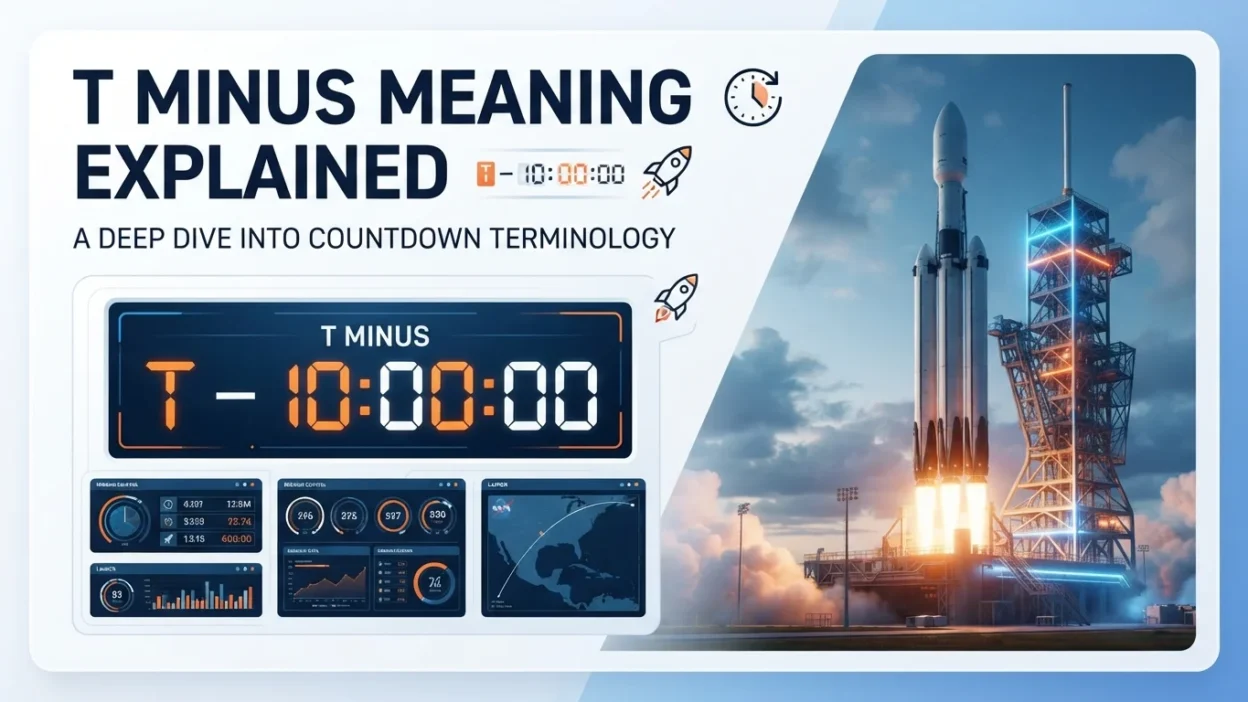
If you have ever heard someone say, “T minus 10 minutes,” you have already heard one of the most useful countdown phrases in English. It sounds technical, but the idea is simple. The phrase tells you how much time is left before something starts.
You might hear it before a rocket launch, a product release, a concert, a meeting, or even a big exam. That is why so many people search for the T minus meaning. They want a clear answer, but they also want to know where the phrase came from, why it is used, and how it differs from terms like T plus and T zero.
Quick Answer
T minus means the amount of time remaining before a planned event begins. For example, T minus 5 minutes means there are 5 minutes left before the event starts.
What Does T Minus Mean?
The phrase T minus is a countdown term used to show time before an event.
- T stands for the planned time of the event.
- Minus means the event has not happened yet.
So if someone says:
- T minus 30 seconds
- T minus 10 minutes
- T minus 2 days
they are all saying the same thing in different units: there is time left before the event begins.
A simple way to think about it is this:
T minus = time remaining before something starts.
What Does T Minus Stand For?
A lot of people search for what does T minus stand for. The answer is straightforward:
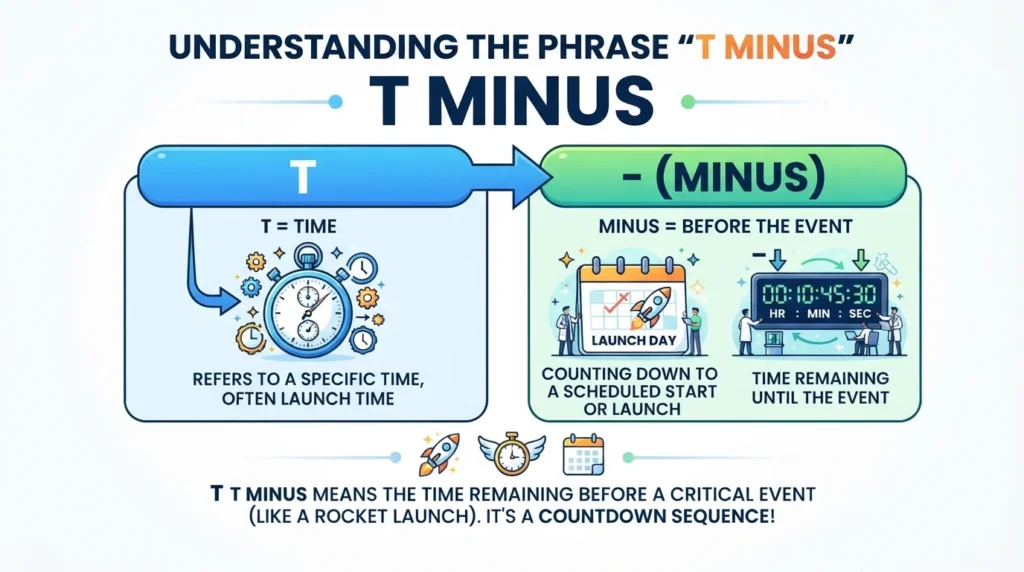
- T = Time
- Minus = Before
Together, they create a countdown marker that tells you how far away you are from the event.
In technical settings, the exact “T” is the target time of the event. That is why the phrase is so useful in launches, operations, and other situations where timing matters.
Where Did T Minus Come From?
The phrase is strongly associated with rocket launches and NASA, but it did not begin there. Countdown terminology was used in military and engineering settings long before space travel became famous.
The reason it became so well known is that launch teams needed a precise and easy way to communicate time before liftoff. Instead of saying “the launch starts in 10 minutes,” they could say T minus 10 minutes. That kept everyone on the same timeline.
Over time, the phrase moved beyond technical use and became part of everyday language.
T Minus Meaning in NASA
When people search for T minus meaning in NASA, they usually want the launch day version of the phrase.
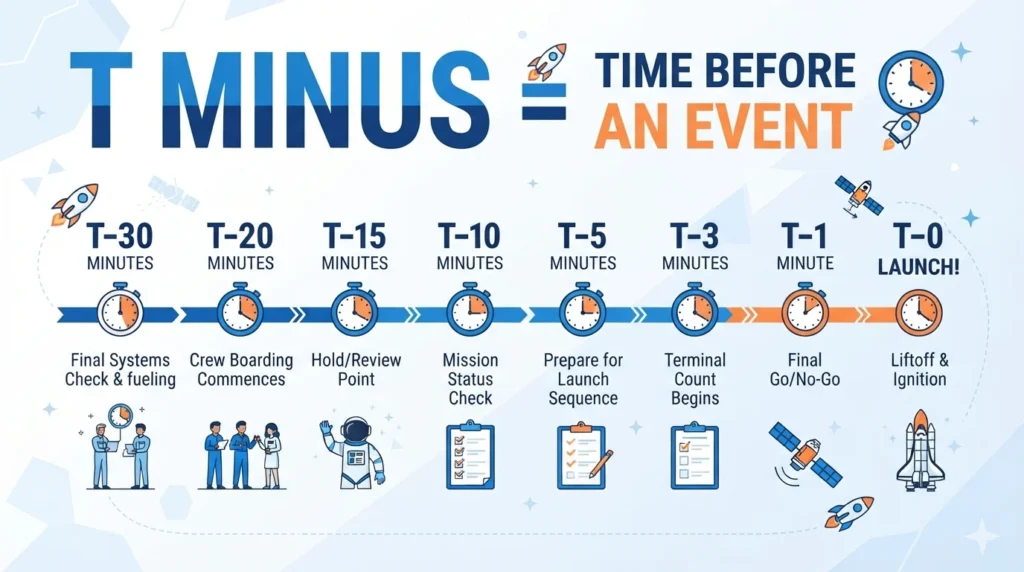
During a rocket launch countdown, mission control may announce:
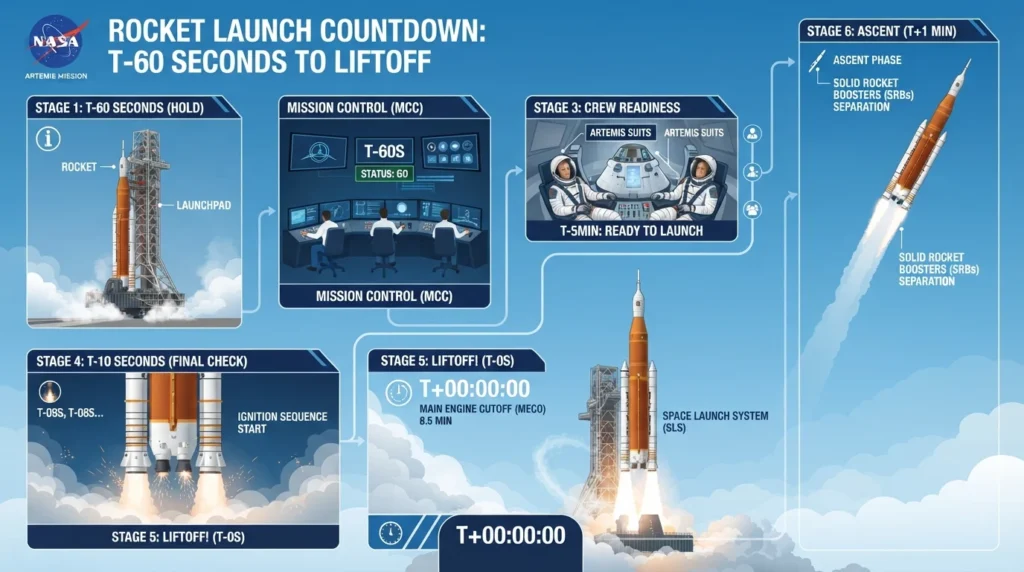
- T minus 20 minutes
- T minus 10 minutes
- T minus 60 seconds
- T minus 10 seconds
- Liftoff
NASA uses countdown language because a launch involves many teams and many final checks. The countdown keeps everyone aligned.
Sometimes the countdown pauses for safety checks. These pauses are part of the process and help ensure the launch is ready before it continues.
T Minus Countdown Meaning
The T minus countdown meaning is simply the process of counting backward toward an event.
Here is a basic example:
| Countdown phrase | Meaning |
| T minus 1 hour | 1 hour left before the event |
| T minus 15 minutes | 15 minutes left |
| T minus 10 seconds | 10 seconds left |
| T | The event begins |
This is why the phrase is so common in launch countdowns, event planning, sports, and live broadcasts.
T Minus vs T Plus
People often search for T minus vs T plus because the two phrases sound similar.
| Term | Meaning | Example |
| T minus | Time before the event | T minus 5 minutes |
| T | The event itself | Launch time |
| T plus | Time after the event | T plus 5 minutes |
So if a launch happens at 3:00 PM:
- T minus 10 minutes = 2:50 PM
- T = 3:00 PM
- T plus 10 minutes = 3:10 PM
That is the easiest way to remember the difference.
What Is T Zero?
A related term is T zero. This is the exact moment the event starts.
In a launch sequence:
- T minus = before launch
- T zero = launch moment
- T plus = after launch
This is one reason the phrase is so helpful. It gives a clean time system for before, during, and after an event.
T Minus Meaning in Everyday Life
Although the phrase started in technical settings, people now use it in normal conversation all the time.
You might hear:
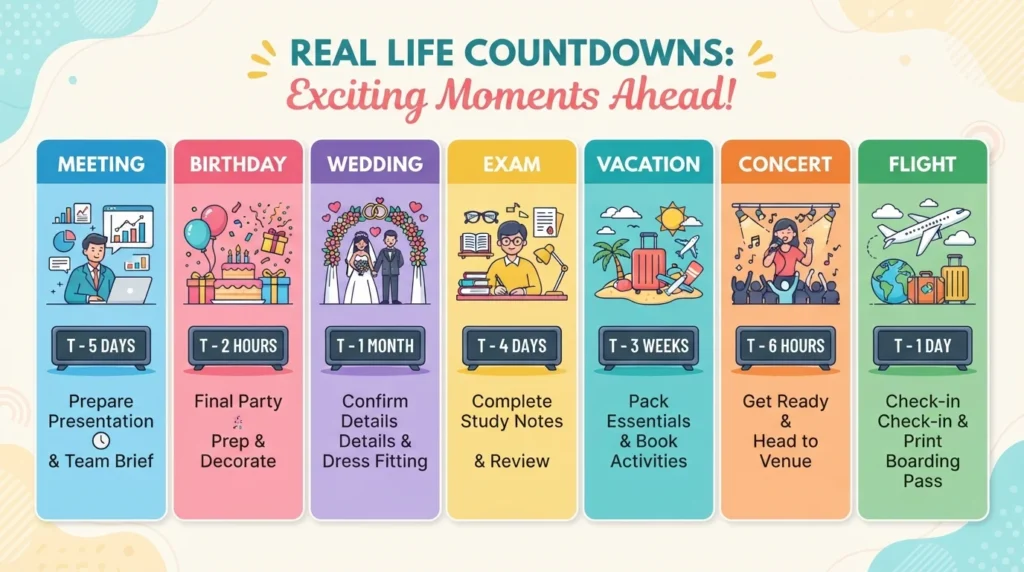
- T minus 2 days until vacation
- T minus 30 minutes until dinner
- T minus 1 hour until the meeting
- T minus 5 minutes until class starts
In these examples, T minus does not mean anything mysterious. It just adds a little energy to the countdown.
T Minus Meaning in Text and Social Media
Many people also look up T minus meaning in text or T minus meaning on social media.
Online, the phrase is often used to build excitement before something happens:

- a concert
- a livestream
- a movie release
- a game update
- a product drop
- a birthday
- a holiday
Examples:
- “T minus 24 hours until the launch.”
- “T minus 1 week until the trip.”
- “T minus 10 minutes until the stream starts.”
It is popular because it sounds sharp, short, and dramatic.
T Minus Meaning in Gaming
Gamers use the phrase too, especially before:
- season updates
- live events
- match starts
- server openings
- tournament launches

Example:
T minus 15 minutes until the patch goes live.
Here, the phrase works just like a countdown clock. It tells players exactly how much time is left.
T Minus Meaning in Military and Operations
The phrase is also common in military and operational settings where timing must be exact.
For example:
T minus 5 minutes until operation start.
In these situations, the countdown helps different teams act at the correct moment. That is why the wording is still useful in high precision environments today.
Why Do People Say T Minus?
People use T minus because it is:
- clear
- short
- precise
- easy to understand
- exciting to hear
It also creates a sense of anticipation. That is why it works so well in both serious and casual settings.
Common T Minus Examples
Here are some natural examples you might see or hear:
- T minus 10 seconds until takeoff.
- T minus 20 minutes until the meeting.
- T minus 3 days until the wedding.
- T minus 1 hour until the concert starts.
- T minus 5 minutes until the app launches.
These examples all follow the same pattern: they show how much time is left before something begins.
Common Mistakes People Make
A few simple mistakes can make the phrase sound awkward.
1. Using T minus after the event
Incorrect:
“T minus 10 minutes after the launch.”
Better:
“T plus 10 minutes after the launch.”
2. Leaving out the event
Incorrect:
“T minus 10 minutes.”
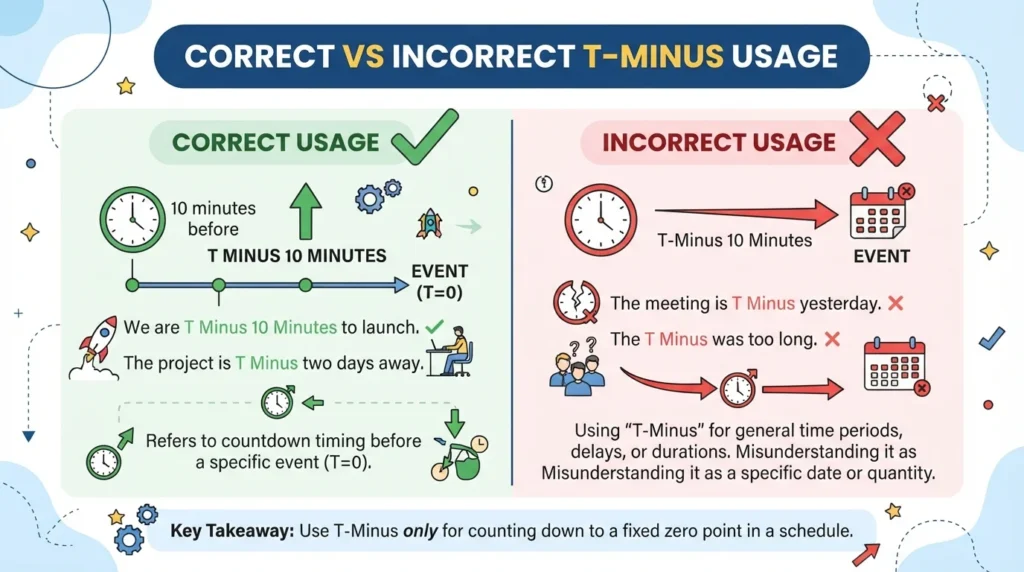
Better:
“T minus 10 minutes until the interview.”
3. Using it for no real countdown
The phrase works best when there is a clear event at the end of the timer.
T Minus Definition in Simple English
T minus is a countdown phrase that means there is still time left before an event begins.
That is the easiest and most accurate way to explain it.
A Quick Comparison of Related Terms
| Term | Meaning |
| T minus | Before the event |
| T zero | The exact event moment |
| T plus | After the event |
| Countdown | The act of counting time toward an event |
Frequently Asked Questions
Is T minus only used by NASA?
No. NASA made it famous, but people now use it in everyday life, sports, gaming, business, and social media.
Does T minus always mean minutes?
No. It can mean seconds, minutes, hours, days, or even weeks. It depends on the event.
What does T minus 0 mean?
It means the event is happening right now.
What is the opposite of T minus?
The opposite is T plus, which means time after the event begins.
Is T minus slang?
Not really. It started as a technical countdown term, but people now use it casually.
Can I use T minus in a sentence?
Yes. For example: “We are T minus 2 days from the launch.”
Final Thoughts
The T minus meaning is simple: it tells you how much time is left before something begins. The phrase comes from countdown systems used in technical fields like aerospace and military operations, but it has now become a common part of everyday language.
Whether you hear it during a rocket launch, a game release, a work meeting, or a social media countdown, T minus always points to the same idea: the event is close, and the clock is still ticking.
Once you understand that T means the event time and minus means before it, the phrase becomes easy to recognise and use.

Roazi is a visionary thinker driven by creativity, innovation, and purpose. With a passion for excellence, he transforms bold ideas into meaningful realities.